
How Long Do Kittens Stay With Their Mothers in the Wild? Guide
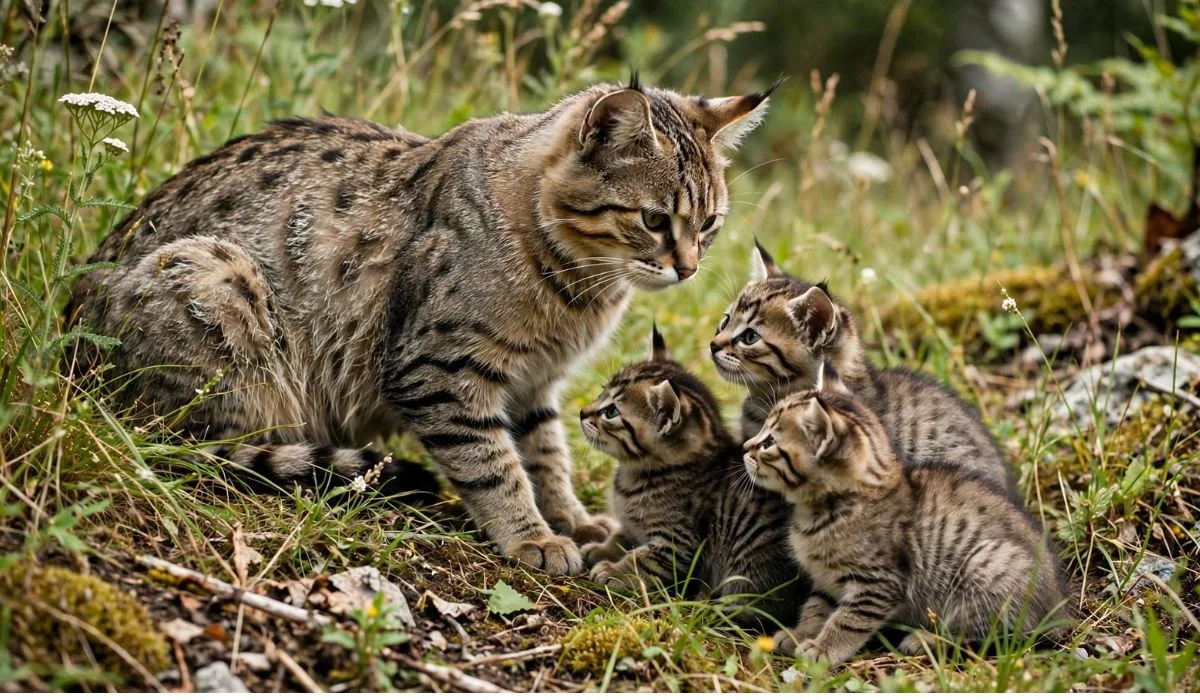
In the wild, a kitten’s relationship with its mother is about much more than nursing. The mother cat provides food, warmth, protection, and opportunities to learn essential survival behaviors. Unlike domestic kittens, young wild cats eventually have to become capable of finding food and avoiding danger without depending on their mother.
So, how long do kittens stay with their mothers in the wild? There is no single age that applies to every wild cat. The answer depends on the species, availability of food, habitat, threats, and how quickly the young develop independence.
For many small wild cats, kittens may remain with their mother for several months, gradually becoming more independent as they learn to hunt and survive. Some species have shorter family associations, while others remain together considerably longer.
It is also important to distinguish wild cats from feral domestic cats. Feral cats are domestic cats living without regular human care, so their family behavior can differ from that of naturally wild feline species.
Why Do Wild Kittens Stay With Their Mothers?
A newborn kitten would have very little chance of surviving alone. During the earliest weeks, the mother provides nearly everything her offspring needs.
She keeps the kittens sheltered, nurses them, protects them from threats, and eventually brings food or teaches them how to obtain it.
Survival depends on learning
Growing up with a mother gives young cats time to develop important skills before becoming independent.
Depending on the species, these skills may include:
- Recognizing potential dangers
- Finding suitable shelter
- Following and observing the mother
- Learning how to locate prey
- Practicing hunting behaviors
- Understanding their territory
- Avoiding larger predators
- Becoming capable of surviving without maternal care
The mother is therefore both a source of protection and an important teacher.
How Long Do Wild Kittens Usually Stay With Their Mothers?
The length of time varies greatly between species.
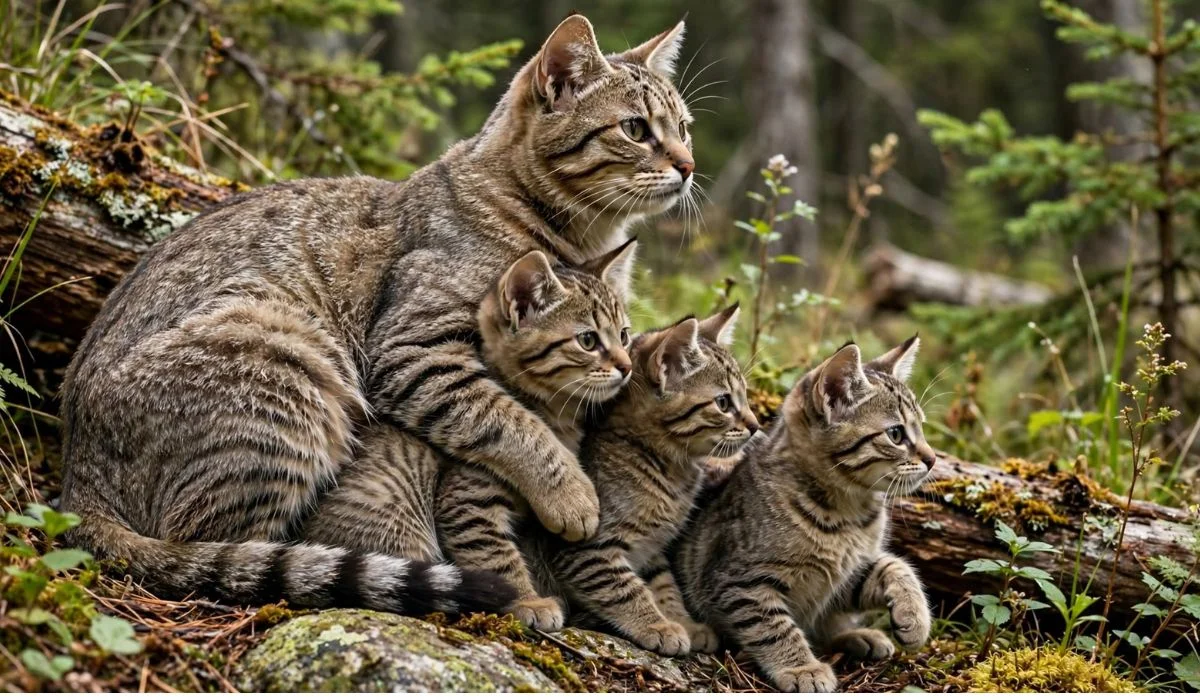
For many small wild cat species, kittens may remain dependent on their mother for several months. They become increasingly independent during this period rather than separating suddenly on a specific day.
Independence develops gradually
A young cat may begin exploring away from the den or shelter while still returning to its mother for food, protection, or social contact.
As its physical abilities improve, maternal dependence decreases.
Eventually, the young cat begins spending more time away from its mother and develops the ability to survive independently.
The Early Weeks Are the Most Dependent
Immediately after birth, wild kittens are particularly vulnerable.
They are small, inexperienced, and unable to survive without substantial maternal care.
Mothers provide essential protection
The mother typically chooses a concealed den or protected location where the kittens can remain hidden from predators and other dangers.
Young kittens spend much of their early development sleeping and feeding. Their physical abilities increase as they grow.
During this stage, leaving the mother would generally be dangerous.
What Happens as Wild Kittens Grow?
The transition from complete dependence to independence happens in stages.
A kitten gradually becomes more mobile, curious, coordinated, and capable of interacting with its environment.
Exploration comes before independence
Young cats may begin venturing farther from their resting area while still remaining close to their mother.
This allows them to experience their surroundings without immediately having to survive completely alone.
As their confidence and physical abilities increase, their movements become less restricted.
When Do Wild Kittens Start Eating Meat?
Carnivorous wild cats eventually need to obtain animal-based food as part of their normal diet, but they do not begin hunting successfully immediately after birth.
The transition from nursing to eating solid food takes place gradually.
Learning to hunt takes time
Young wild cats may initially observe their mother during feeding or hunting activities.
Depending on the species, the mother may provide prey for the young or allow them to interact with prey as they develop their skills.
A kitten that can physically chase an animal is not necessarily ready to survive entirely on its own.
Do Mother Cats Teach Kittens to Hunt?
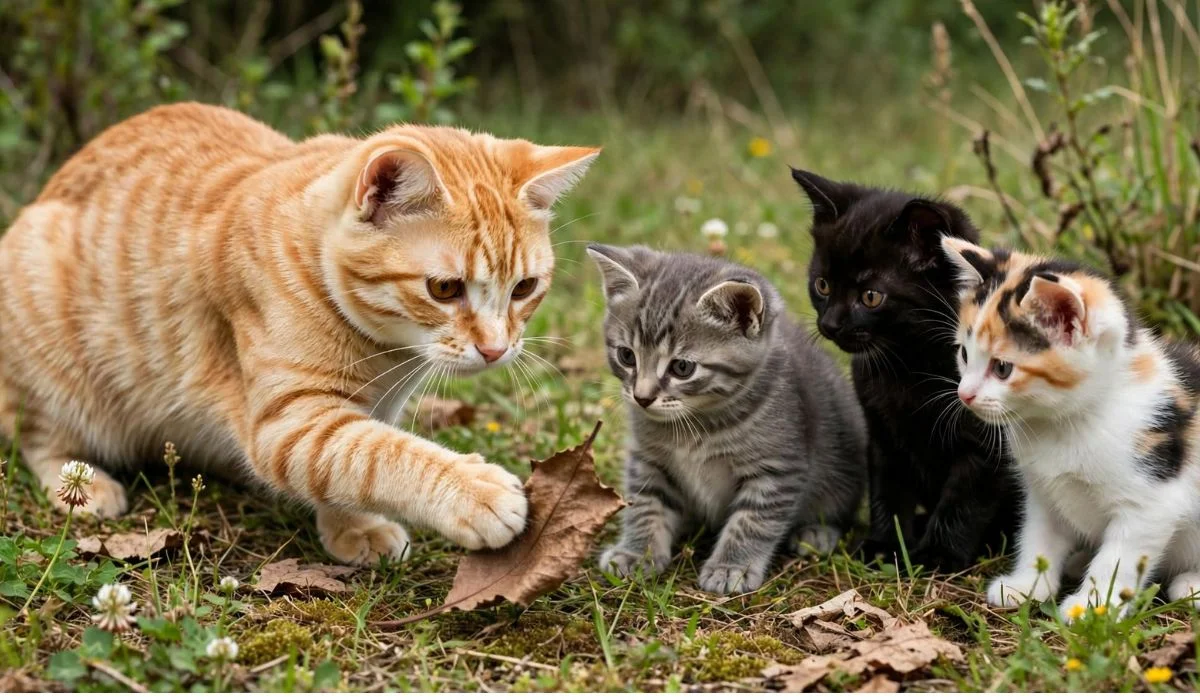
In many wild cat species, mothers play an important role in exposing their young to hunting behaviors.
However, hunting is not necessarily a formal lesson. Young cats often learn through observation, play, practice, and repeated experience.
Practice helps develop coordination
Chasing, pouncing, stalking, and playing can help young cats develop physical coordination and behaviors that later become useful during hunting.
The exact learning process varies between species.
When Do Wild Kittens Become Independent?
There is no universal independence age for wild kittens.
Some young cats become independent after several months, while others remain associated with their mother for longer.
Species makes a major difference
A small solitary wild cat may follow a different developmental pattern from a larger species.
For example, large cats such as lions have very different social structures from solitary species such as many small wild cats.
This is why the phrase “wild kitten” should not be treated as describing one standard life cycle.
How Long Do Lion Cubs Stay With Their Mothers?
Lion cubs are an interesting exception because lions are highly social compared with many other wild cats.
Cubs typically remain within the pride while growing and learning. They can continue depending on adults for an extended period as they develop.
Pride life changes the family dynamic
Lion cubs are not simply raised by one mother in isolation. Other members of the pride can influence their social environment and protection.
This differs significantly from solitary wild cats, where a mother may raise kittens largely on her own.
How Long Do Tiger Cubs Stay With Their Mothers?
Tiger mothers generally raise their cubs without a permanent social group of other adult tigers.
Tiger cubs remain with their mother while they develop hunting and survival skills.
Tigers need considerable time to learn
A young tiger must become physically capable of finding food and navigating its environment before living independently.
The mother therefore remains an important part of the cubs’ development until they are sufficiently prepared to survive on their own.
What About Bobcat Kittens?
Bobcats are generally solitary animals, and mothers raise kittens on their own.
The kittens remain with their mother while developing the abilities needed for independent survival.
Separation eventually becomes necessary
As young bobcats mature, they gradually leave the maternal relationship and establish their own lives.
The exact timing can vary depending on the individual and environmental conditions.
Why Do Wild Mother Cats Eventually Leave Their Kittens?
In species where young eventually become independent, separation is a natural part of development.
The goal is not for the mother and offspring to remain together permanently.
Independence reduces competition
As young cats grow larger, they require more food and space. Remaining dependent on the mother indefinitely would create competition for limited resources.
Natural separation allows the young animal to establish itself and allows the mother to reproduce again in species that follow that pattern.
Do Wild Kittens Return to Their Mothers?
They may, depending on the species and stage of development.
During the period when kittens are becoming independent, they may still spend considerable time with their mother.
The relationship changes over time
A young cat can become increasingly independent while still maintaining contact with its mother.
Eventually, however, the level of interaction generally decreases as the young animal establishes its own territory or social position.
What Factors Affect How Long Kittens Stay With Their Mothers?
Several environmental and biological factors can influence the timing of independence.
Food availability
If food is abundant, young animals may have better opportunities to develop and survive.
Limited food can increase competition and affect family dynamics.
Predators and other threats
Young cats face risks from predators, competitors, and environmental hazards. A mother may keep young animals close while they remain vulnerable.
Species and social structure
Solitary cats and social cats have very different family arrangements.
A lion cub’s development, for example, cannot be compared directly with that of a solitary wild cat.
Individual development
Even within the same species, young animals do not all mature at precisely the same rate.
Do Wild Kittens Stay With Their Mothers Longer Than Domestic Kittens?
The comparison is not always straightforward.
Domestic kittens often begin weaning during the first several weeks of life and can become nutritionally independent at around two months. However, being able to eat independently does not necessarily mean a kitten is ready to live alone.
In the wild, a young cat may need considerably more time to develop the skills necessary for survival.
Food independence is not the same as survival independence
A kitten that can eat solid food still may not know how to find food, avoid predators, navigate its surroundings, or establish a safe territory.
This distinction is especially important when comparing domestic and wild cats.
What Can Young Cats Learn From Their Mothers?
Maternal care can provide young wild cats with valuable experience.
Depending on the species, offspring may learn:
- Where to find food
- How to approach prey
- Where to seek shelter
- How to respond to threats
- How to move through their habitat
- How to interact with other animals
- How to use their developing physical abilities
Play can be part of development
Young cats frequently engage in play involving chasing, pouncing, wrestling, and stalking-like movements.
These activities can help develop coordination and social or hunting-related skills.
What Happens After a Wild Kitten Leaves Its Mother?
Leaving the mother is only the beginning of independent life.
The young cat must use the physical and behavioral abilities developed during its early months.
Young cats face new challenges
Once independent, a young wild cat may need to find food, locate shelter, avoid predators, and eventually establish an appropriate home range or territory.
Survival can remain challenging even after maternal dependence ends.
Why You Should Not Assume a Wild Kitten Is Abandoned
Finding a young wild cat alone does not automatically mean it has been abandoned.
A mother may be nearby and temporarily away while searching for food or responding to a disturbance.
Observe before intervening
If you encounter a wild animal that appears healthy, avoid approaching, feeding, or attempting to raise it yourself.
Wildlife authorities, licensed rehabilitators, or veterinarians with wildlife experience can provide appropriate advice when an animal genuinely appears injured, sick, or orphaned.
How Long Do Kittens Stay With Their Mothers in the Wild?
The short answer is: it varies by species, but many wild kittens remain with their mothers for several months while they develop survival skills.
There is no universal age at which every wild kitten separates.
The mother-offspring relationship usually changes gradually. Nursing decreases, solid food becomes important, exploration increases, hunting skills develop, and eventually the young cat becomes capable of living independently.
The Bottom Line
Wild kittens stay with their mothers because survival requires more than simply growing big enough to eat solid food.
A mother provides protection and nourishment during the vulnerable early stages and, in many species, gives her young opportunities to develop behaviors needed for independent life.
For many wild cats, the family relationship lasts several months, but the exact period depends heavily on the species, habitat, food supply, social structure, and individual development.
Understanding this natural process is also useful when encountering young wildlife. A kitten or cub seen alone is not necessarily orphaned, and unnecessary human intervention can sometimes do more harm than good.
FAQs About Wild Kittens Staying With Their Mothers
How long do kittens stay with their mothers in the wild?
The answer varies by species. Many wild cat kittens remain with their mothers for several months while developing feeding, hunting, and survival skills.
Do wild kittens stay with their mothers longer than domestic kittens?
They can. Domestic kittens may become nutritionally independent at around 7 to 8 weeks, but wild kittens often need additional time to develop the skills required to survive without maternal support.
At what age do wild kittens become independent?
There is no single age for all wild cats. Independence commonly develops gradually over several months, with the timing differing among species.
Do mother cats teach their kittens to hunt?
In many wild cat species, mothers play an important role in their young’s development by providing opportunities to observe, practice, and develop hunting behaviors.
Do wild kittens stay with their mothers after they stop drinking milk?
Yes, they can. Stopping nursing does not necessarily mean a young wild cat is immediately independent. It may continue living with or following its mother while learning other survival skills.
How long do tiger cubs stay with their mothers?
Tiger cubs generally remain with their mother while developing the skills needed for independent survival. They require considerable time to learn how to hunt and navigate their environment.
How long do lion cubs stay with their mothers?
Lion cubs remain within their pride while growing and developing. Their social upbringing differs from that of solitary wild cats because several members of the pride may be involved in their environment and protection.
Do wild kittens return to their mothers after exploring?
Young animals may continue returning to or staying near their mother during the period when they are becoming independent. Their dependence generally decreases as they mature.
What happens when a wild kitten leaves its mother?
The young cat begins living more independently and must increasingly find food, shelter, and safety without relying on maternal care. Depending on the species, it may eventually establish its own territory or social position.
Should I rescue a wild kitten I find alone?
Not automatically. A young wild animal may have a mother nearby. If the animal appears injured, sick, or genuinely orphaned, contact an appropriate wildlife rehabilitator or local wildlife authority for guidance rather than attempting to raise it yourself.
Are wild kittens the same as feral kittens?
No. Wild cats are naturally occurring wild species, while feral cats are domestic cats living without regular human care. Their behavior, development, and social structures can be different.
Why do wild mother cats eventually leave their kittens?
The young eventually become capable of surviving independently. Separation can also reduce competition for food and space and allows the mother to continue her own life and, in many species, reproduce again.


