Best Interactive Cat Toys for Bored Indoor Cats | Guide On
Indoor cats may have a comfortable home, regular meals, and a cozy place to sleep, but they still need activities that challenge their natural instincts. Without enough stimulation, some cats become restless, scratch furniture, knock objects off shelves, demand constant attention, or spend most of the day sleeping.
Interactive cat toys can make indoor life more interesting by encouraging cats to chase, stalk, pounce, bat, explore, and solve simple problems. Unlike ordinary plush toys, many interactive options respond to a cat’s movements or require the cat to work for a reward.
However, not every toy suits every personality. Some cats love chasing moving objects, while others prefer food puzzles, tunnels, or toys they can grab and kick. Choosing the right type can make playtime more enjoyable and help prevent boredom.
This guide explores some of the best interactive cat toys for bored indoor cats, what makes each type useful, and how to choose safe options for your pet.
Best Interactive Cat Toys for Bored Indoor Cats | Guide On:
1. Automatic Moving Cat Toys
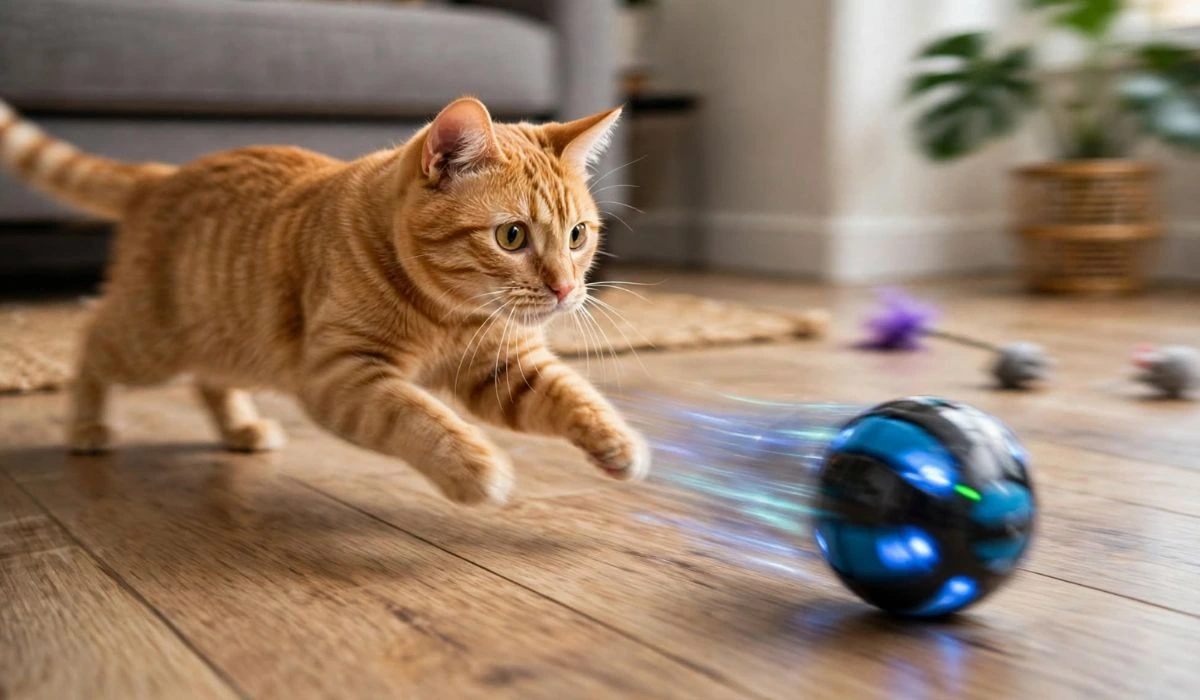
Automatic moving toys are a popular choice for cats that enjoy chasing unpredictable objects. These devices use small motors to move across the floor, change direction, or imitate the movement of prey.
Some models include motion sensors, rechargeable batteries, or different speed settings. Their changing movements can encourage a cat to stalk, follow, and pounce.
Why cats may enjoy them:
- They create movement without requiring constant human involvement.
- Different movement patterns can make play sessions less predictable.
- They encourage indoor cats to get up and move.
- Some models offer short automatic play cycles.
What to consider: Choose a model with securely covered moving parts and a protected battery compartment. Introduce it while supervising your cat, especially if it has detachable accessories.
2. Interactive Feather Wand Toys
A feather wand is a simple but effective way to turn ordinary playtime into a hunting game. It usually consists of a long handle, a flexible string, and a feather or fabric attachment.
You control the movement, making the attachment flutter, slide, or disappear behind furniture. This allows you to imitate the behavior of a small bird or other moving prey.
Main benefits:
- Encourages chasing, jumping, and pouncing.
- Helps strengthen the bond between cats and their owners.
- Allows you to adjust the speed and difficulty.
- Works for both energetic adult cats and playful kittens.
Important safety tip: Always supervise wand play. Put the toy away afterward because swallowed string, ribbon, or elastic can cause serious intestinal problems.
3. Ball-and-Track Cat Toys
Ball-and-track toys provide an entertaining activity for cats that enjoy batting and chasing small objects. These toys usually contain one or more balls inside a circular or multi-level track.
A cat can push a ball with its paw and watch it roll around the track. Since the ball stays inside the structure, it is less likely to disappear underneath furniture.
Some designs include multiple levels, curved tracks, or additional scratching surfaces.
Why they are useful:
- Encourage independent play.
- Provide an activity that does not require batteries.
- Support natural pawing and batting behaviors.
- Can be suitable for homes with more than one playful cat.
Look for a sturdy design with smooth edges and securely enclosed balls. Check regularly for cracks or loose pieces.
4. Treat-Dispensing Puzzle Toys
Treat-dispensing toys combine playtime with problem-solving. Instead of receiving every treat directly from your hand, your cat must move, roll, push, or manipulate the toy to release the food.
Some models have adjustable openings, while others contain several compartments that require different actions.
These toys can be particularly useful for food-motivated cats that quickly lose interest in ordinary playthings.
Benefits include:
- Encouraging curiosity and problem-solving.
- Making snack time more engaging.
- Providing mental stimulation.
- Slowing down some cats that eat too quickly.
Start with an easy setting so your cat can understand how the toy works. Use small portions of your cat’s normal daily food allowance rather than adding too many extra treats.
5. Electronic Hide-and-Seek Toys
Electronic hide-and-seek toys create the impression that something is moving underneath a surface or inside a covered structure. A small feather or other attachment may appear briefly before disappearing again.
This type of movement can encourage cats to watch carefully, wait, and make sudden pounces.
It may be especially interesting for cats that enjoy hunting games but become bored with toys that move in predictable circles.
Features worth looking for:
- Random or changing movement patterns.
- A stable base that does not slide easily.
- Securely attached moving components.
- An automatic shutoff function.
- A design that is easy to clean.
These toys should be introduced under supervision. Do not assume that an electronic toy is safe for unattended use simply because it has an automatic timer.
Read Next: Chances of Finding a Lost Cat After 3 Days: What Are the Odds?
6. Interactive Cat Tunnels
Cat tunnels provide more than a hiding place. They create opportunities for exploring, chasing, ambushing, and playing hide-and-seek.
Some tunnels have several openings, crinkly material, hanging toys, or connecting sections. You can place a ball or wand toy near an entrance to encourage your cat to investigate.
Why tunnels are useful:
- Give curious cats a place to explore.
- Encourage movement and playful ambushes.
- Provide hiding spots for shy cats.
- Add variety to a small indoor play area.
Choose a tunnel made from durable, non-toxic material. Check its seams and openings, and remove damaged sections if your cat begins chewing or pulling them apart.
7. Motion-Activated Cat Balls
Motion-activated balls are designed to respond when a cat touches or approaches them. Depending on the model, the ball may roll, vibrate, change direction, or produce a gentle sound.
Their movement can encourage cats to chase them across a room.
These toys are worth considering for cats that enjoy following moving objects but need something different from a traditional ball.
Look for these features:
- A size appropriate for your cat.
- Smooth, durable construction.
- Secure battery covers.
- Manageable sound levels.
- Rechargeable power, if preferred.
Watch your cat during the first few sessions. Some cats enjoy electronic movement, while others may find sudden noises or vibrations frightening.
8. Catnip-Infused Kicker Toys
Kicker toys are usually long, soft toys that cats can hold with their front paws while kicking with their back legs.
Some contain catnip, which may attract cats that respond to its scent. Others use silvervine or have crinkly materials to create additional interest.
These toys are especially useful for cats that enjoy wrestling rather than chasing.
Advantages:
- Encourage grabbing and kicking.
- Provide an appropriate object for wrestling.
- Offer a different play style from electronic toys.
- Can be used during short independent play sessions.
Choose a toy with strong stitching and no easily removable decorations. Check it regularly for torn fabric, loose filling, or exposed contents.
9. Interactive Food Mats
Interactive feeding mats turn ordinary meals into a small activity. Food is placed in different grooves, pockets, or textured sections, encouraging cats to search for individual pieces.
Unlike a standard food bowl, a suitable feeding mat can make mealtime more engaging.
Why consider one?
- Encourages natural foraging behavior.
- Adds variety to daily feeding.
- May slow down fast eaters.
- Provides a low-energy activity for older cats.
Select a mat made from pet-safe, easy-to-clean material. Make sure the grooves are suitable for the type of food you serve, and wash the mat regularly to prevent food residue from building up.
10. Interactive Laser Toys
Laser toys create a moving light that cats may chase across floors and walls. Some electronic models move the light automatically, while handheld versions allow owners to control its direction.
They can encourage movement, but there is one important limitation: a cat cannot physically catch a light.
For this reason, laser play should not be the only type of hunting activity your cat receives. Finish the session by directing your cat toward a physical toy or offering a small food reward so the activity has a satisfying conclusion.
Never point a laser directly into a cat’s eyes or allow an automatic laser to operate without supervision.
11. Cat Puzzle Boards
Puzzle boards contain small spaces, sliding sections, cups, or compartments where treats can be hidden. Cats must use their paws and noses to discover how to reach the reward.
Unlike a moving electronic toy, a puzzle board challenges a cat’s ability to investigate and solve a problem.
Best features to consider:
- Multiple puzzle sections.
- Different difficulty levels.
- Stable construction.
- Easy-to-clean surfaces.
- No small detachable pieces.
Begin with visible treats and simple compartments. Once your cat understands the activity, introduce more challenging sections.
12. Interactive Flapping Fish Toys
Flapping fish toys imitate the movement of a fish by moving their tails when activated. Many models use a rechargeable mechanism and a motion sensor.
A cat may tap the toy, causing it to move and encouraging grabbing, biting, and kicking.
This type of toy may appeal to cats that prefer wrestling with soft objects rather than chasing balls.
Before buying, check the quality of the fabric, battery enclosure, stitching, and charging system. Supervise early play sessions and stop using the toy if the fabric tears or the mechanism becomes exposed.
13. Cat Spring Toys
Spring toys are lightweight objects that cats can bat, chase, and carry. Their flexible shape can create unpredictable movement when pushed across a hard floor.
They do not require batteries, complicated settings, or charging.
Why they can be useful:
- Encourage quick reactions and paw coordination.
- Provide inexpensive entertainment.
- Are easy to move around the home.
- Can be used alongside tunnels and other play structures.
Choose appropriately sized springs without sharp edges. Inspect them frequently and remove any that become damaged or small enough to swallow.
14. Interactive Window Perches
A window perch is not a traditional toy, but it can provide valuable visual stimulation for an indoor cat. From a secure viewing position, cats can watch birds, insects, passing vehicles, and other outdoor activity.
Some cats spend long periods observing the world outside.
To make the experience more interesting, place a suitable perch near a safe window and occasionally introduce a nearby toy.
Important considerations:
- Make sure the perch is securely installed.
- Check that the window cannot open wide enough for an escape.
- Avoid unsafe window screens.
- Provide shade and a comfortable resting area.
A window perch works best as part of a broader enrichment setup rather than a replacement for active play.
15. Multi-Activity Cat Play Centers
Multi-activity play centers combine several features in one structure. Depending on the design, they may include ball tracks, scratching surfaces, hanging attachments, tunnels, or puzzle sections.
They can be a practical option for households that want several activities without purchasing many separate toys.
Potential benefits:
- Offer different play options in one place.
- Encourage exploration.
- Provide opportunities for batting and scratching.
- Can make a dedicated play area more interesting.
Check the overall stability of the structure and the security of every attachment. A larger toy is not automatically a better choice; it should match your cat’s size, interests, and activity level.
How to Choose the Right Interactive Toy for Your Cat
The best choice depends on how your cat naturally plays. Observe its behavior before spending money on several products.
| Your cat’s behavior | Toy to consider |
|---|---|
| Chases moving objects | Automatic moving ball |
| Loves jumping and catching | Feather wand |
| Enjoys batting objects | Ball-and-track toy |
| Searches for food | Treat puzzle |
| Likes hiding and exploring | Interactive tunnel |
| Grabs and kicks toys | Soft kicker |
| Enjoys investigating | Puzzle board |
| Watches outdoor activity | Window perch |
Consider Your Cat’s Age
Kittens often enjoy toys that move quickly and encourage short bursts of activity. Adult cats may enjoy a combination of chasing, puzzle-solving, and independent play.
Older cats may prefer slower-moving toys, accessible puzzles, and gentle activities. Adjust the intensity to your cat’s mobility and comfort.
Check the Material and Construction
Avoid toys with loose strings, exposed wires, sharp edges, or small detachable parts. Choose products made from durable materials and follow the manufacturer’s cleaning and maintenance instructions.
Think About Your Available Space
A large tunnel or multi-level play center may not fit comfortably in a small apartment. A compact track toy, puzzle board, or wand may be more practical.
Introduce New Toys Gradually
Some cats immediately investigate new objects, while others need time to become comfortable. Place a new toy in a familiar area and allow your cat to approach it voluntarily.
How to Keep Indoor Cats Interested in Their Toys
Buying an expensive toy does not guarantee that a cat will use it regularly. Variety and interaction are just as important as the toy itself.
Rotate toys: Keep some toys out of sight and introduce them at different times. This can make familiar objects feel interesting again.
Create short play sessions: Several short sessions throughout the day may work better than expecting a cat to play continuously.
Use different play styles: Combine chasing, batting, food puzzles, and exploration to provide variety.
Follow your cat’s interests: If your cat ignores a particular toy, try another movement or texture rather than forcing interaction.
Allow successful catches: During wand play, let your cat catch the attachment occasionally. This gives the hunting game a more satisfying ending.
Safety Tips for Interactive Cat Toys
Interactive toys should provide entertainment without creating unnecessary risks.
- Supervise toys that contain strings, ribbons, feathers, or elastic.
- Store wand toys safely after each session.
- Check electronic toys for exposed wires and damaged battery compartments.
- Remove broken toys and loose components immediately.
- Avoid toys that are small enough to swallow.
- Keep laser lights away from your cat’s eyes.
- Clean food puzzles and feeding mats regularly.
- Follow age and weight recommendations from manufacturers.
If your cat swallows string, ribbon, or another potentially dangerous object, contact a veterinarian promptly. Do not pull visible string from the mouth or rectum.
Frequently Asked Questions
What are the best interactive cat toys for bored indoor cats?
Automatic moving toys, feather wands, ball tracks, treat puzzles, tunnels, and kicker toys are useful options. The best choice depends on whether your cat prefers chasing, hunting, exploring, or solving problems.
How can I entertain my indoor cat while I am busy?
Provide suitable independent-play options, such as a secure ball track, a puzzle feeder, or a sturdy cat tunnel. Make sure the toy is appropriate for unsupervised use, and put away items containing strings, ribbons, or detachable parts.
How many toys should an indoor cat have?
There is no fixed number that works for every cat. A small collection of different toy types is often more useful than having many nearly identical toys. Rotate them to maintain interest.
Are automatic cat toys worth buying?
They can be useful for encouraging movement and independent play. However, some cats dislike motors or unpredictable movements. Introduce automatic toys gradually and supervise your cat until you understand how it interacts with them.
Do interactive toys help cats lose weight?
Interactive toys can encourage physical activity, which may support a healthy weight-management routine. However, weight control also depends on appropriate food portions, nutrition, and veterinary guidance.
How long should I play with my indoor cat each day?
There is no single daily duration suitable for every cat. Several short play sessions can be a practical starting point. Adjust the frequency and intensity according to your cat’s age, health, and interest.
Are laser toys safe for cats?
Laser toys can be used carefully, but never shine the light into a cat’s eyes. Because cats cannot physically catch the light, finish play with a catchable toy or food reward.
Why does my cat lose interest in new toys?
Cats may become familiar with repeated movements, textures, and sounds. Try rotating toys, changing how you use them, and choosing activities that match your cat’s preferred play style.
Final Thoughts
Keeping an indoor cat entertained requires more than providing a collection of ordinary toys. Cats benefit from opportunities to chase, stalk, explore, solve problems, and interact with their owners.
Start with a few different options, such as a feather wand, a ball track, and a treat puzzle. Observe which activities your cat enjoys most, then build a simple play routine around those preferences.
The goal is not to buy the most expensive interactive toy. It is to create a safe, stimulating environment where your cat can stay curious, active, and mentally engaged.